.png)
YPIE Scientist: Ashley Daniel
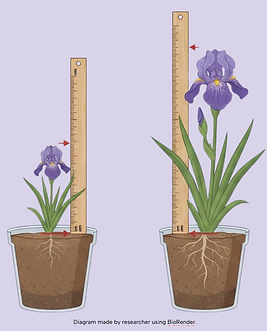
Research: Comparative Nutrient Uptake Efficiency of Iris versicolor and Iris pseudacorus in Controlled Mesocosm Systems
Mentor: Erin Snyder
Research Location: Teatown Lake Reservation
Awards: Teatown Young Environmentalist Award (WESEF 2026), Regeneron Science Talent Search 2025, Somers Science Fair Participant 2024, Environthon Participant 2025 & 2026
Abstract:
Excessive inputs of nitrates and phosphates cause eutrophication in aquatic ecosystems, necessitating the need for feasible nutrient removal methods. This study examined the phytoremediation potential of native Iris versicolor and non-native Iris pseudacorus in 27 controlled mesocosms over low, medium, and high nutrient concentrations. Water quality parameters, such as pH, dissolved oxygen (DO), chlorophyll a, nitrate, and phosphate were monitored on a weekly basis, and plant growth was measured as percent height change. A two-way ANOVA showed that plant species significantly affected pH (p < 0.0001)**, DO (p < 0.005), chlorophyll a (p < 0.01), and plant growth (p < 0.0001), while nutrient concentration and species-concentration interactions were not significant (p > 0.05). I. versicolor had greater reductions in pH and DO and consistently had greater percent height change in all treatments. There were no significant reductions of nitrate or phosphate concentrations in either species, suggesting uptake equilibrium or an insufficient experiment duration to detect removal. These findings suggest that the native iris, I. versicolor, might be more robust and reliable for influencing water chemistry compared to the invasive and competitive species, I. pseudacorus. The results have provided support for I. versicolor as a promising sustainable candidate for phytoremediation in nutrient-enriched waters and indicated further long-term studies incorporating biomass and tissue nutrient analyses for better assessment of removal efficiency.
About this Scientist:
Ashley Daniel is a senior who is currently pursuing her IB Diploma at Yonkers Middle High School. She will be attending Case Western University as a biomedical engineering major in the fall. After college, she plans to attend medical school to become a cardiothoracic surgeon, as well as receive her masters degree in biomedical engineering to pursue higher level research with a focus on developing biomaterial-based cardiac patches to support heart tissue regeneration post-myocardial infarction.


I found the article helpful because it gives readers enough information without making the discussion complicated. During some further browsing, I came across joya 999. Exploring related resources can be a good way to understand different forms of interactive online content and discover useful information.
Because the content is community-edited, an open women's knowledge base can reflect a range of perspectives that a single author might not cover.
Few moments in friday night funkin are more rewarding than reaching the end of a song that previously seemed too difficult. Success reflects better timing, stronger pattern recognition, and improved control developed across earlier attempts. The journey from missing rapid combinations to handling them confidently gives challenging tracks a clear sense of progression. Alongside its upbeat presentation and memorable musical battles, this skill growth provides a compelling reason to keep playing and tackle another performance.
I just finished reading "YPIE Scientist: Ashley Daniel", and the structure made the key ideas easy to follow. A detail that stayed with me: YPIE Scientist: Ashley Daniel Jun 1 2 min read Research: Comparative Nutrient. Appreciate you publishing this. play harmonium online
Impressive work from such a young researcher. It is nice to see environmental science and healthcare goals coming together. Detailed studies like this often benefit from careful proofreading services before reaching wider audiences.